Financial Calculators HubIPO CenterTrade SimulatorDictionary (A–Z)# NSE IPO 2026: Price Band, Dates, Lot Size, Subscription and Key Details
The much-awaited Initial Public Offering of the National Stock Exchange of India Limited has opened for subscription on September 17, 2026.
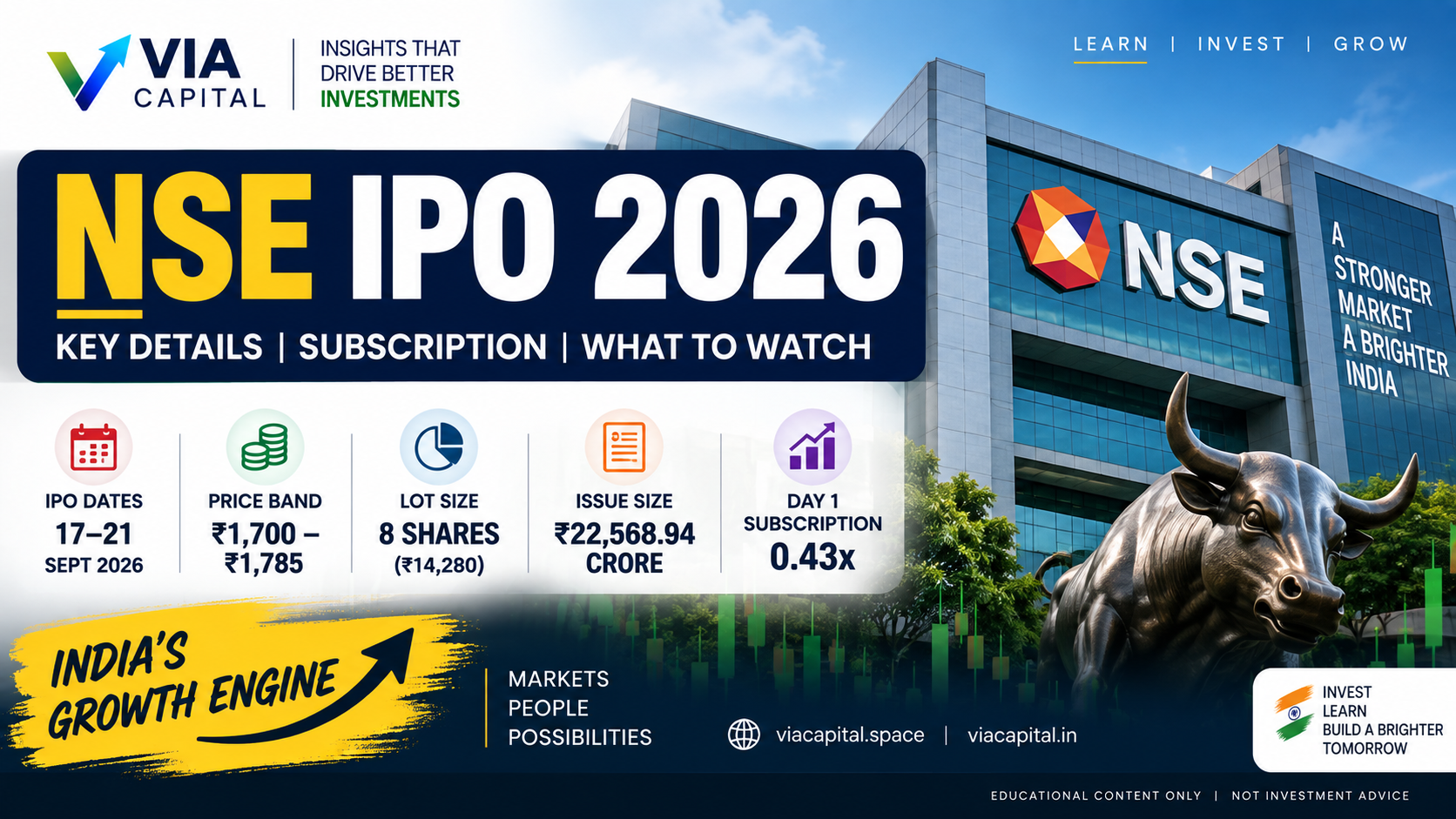
The IPO has a price band of ₹1,700–₹1,785 per equity share, with a minimum bid of 8 shares. At the upper price band, the minimum application amount is ₹14,280.
The issue is entirely an Offer for Sale (OFS), meaning the money raised from the public offer will go to the existing selling shareholders rather than to NSE itself.
The IPO will remain open until September 21, 2026.
NSE IPO: Key Details
| Detail | Information |
|---|---|
| Company | National Stock Exchange of India Limited |
| IPO Type | Mainboard IPO |
| Issue Type | Book Built |
| IPO Open Date | September 17, 2026 |
| IPO Close Date | September 21, 2026 |
| Price Band | ₹1,700–₹1,785 |
| Face Value | ₹1 per share |
| Lot Size | 8 shares |
| Minimum Investment | ₹14,280 at upper band |
| Total Offer | Up to 12,64,36,650 shares |
| Approx. Offer Value | Up to ₹22,568.94 crore |
| Fresh Issue | Nil |
| Offer for Sale | Up to 12,64,36,650 shares |
| QIB Reservation | Not more than 50% |
| NII Reservation | Not less than 15% |
| Retail Reservation | Not less than 35% |
| Employee Discount | ₹170 per share |
| Proposed Listing | BSE |
| Registrar | MUFG Intime India |
| Book Running Lead Managers | Multiple lead managers led by Kotak Mahindra Capital, JM Financial, Morgan Stanley, Citi and HSBC |
The official NSE issue information confirms the ₹1,700–₹1,785 price range, 8-share lot size and offer of up to 12,64,36,650 shares. :contentReference[oaicite:1]{index=1}
What Is the NSE IPO?
The National Stock Exchange of India is one of India's largest financial market infrastructure institutions.
NSE began operations in 1994 and introduced electronic or screen-based trading in India. Its business includes exchange trading, clearing and settlement, listings, indices, market data and technology-related services.
According to NSE, it has ranked as India's largest stock exchange by total and average daily turnover in equity shares every year since 1995, based on SEBI data. NSE also says it was the world's largest derivatives exchange by trading volume in calendar year 2025, based on Futures Industry Association statistics. :contentReference[oaicite:2]{index=2}
NSE IPO Price Band and Lot Size
The IPO price band has been fixed at:
₹1,700 to ₹1,785 per share
The minimum bid is 8 shares.
At the upper price band:
8 × ₹1,785 = ₹14,280
Therefore, a retail investor applying for one minimum lot needs ₹14,280, assuming the bid is placed at the upper end of the price band.
Investors can bid in multiples of 8 shares, subject to the applicable category limits. :contentReference[oaicite:3]{index=3}
NSE IPO Issue Size
The NSE IPO comprises an Offer for Sale of up to 12,64,36,650 equity shares.
There is no fresh issue of shares.
At the upper price band of ₹1,785, the total offer value works out to approximately ₹22,568.94 crore.
Because the issue is entirely an OFS, NSE will not receive the IPO proceeds. The proceeds will go to the existing shareholders selling their shares.
The final RHP reduced the proposed offer size from the larger number contemplated in the earlier DRHP. :contentReference[oaicite:4]{index=4}
Who Is Selling Shares in the NSE IPO?
The selling shareholders include several institutional investors and financial institutions.
The RHP identifies selling shareholders including:
- State Bank of India
- Canada Pension Plan Investment Board
- Aranda Investments (Mauritius) Pte Ltd
- MS Strategic (Mauritius) Ltd
- The New India Assurance Company Ltd
- SBI Capital Markets Limited
- Bank of Baroda
- Stock Holding Corporation of India Limited
- General Insurance Corporation of India Limited
- United India Insurance Company Limited
The final quantities offered by individual shareholders vary, with several shareholders reducing their proposed sale compared with the earlier draft offer document. :contentReference[oaicite:5]{index=5}
NSE IPO Investor Reservation
The public issue follows the standard broad allocation structure for a mainboard book-built IPO:
| Investor Category | Reservation |
|---|---|
| QIB | Not more than 50% |
| NII | Not less than 15% |
| Retail | Not less than 35% |
The final allocation can be affected by the specific issue structure and applicable regulations.
The employee reservation is separate, with the eligible employee portion carrying a ₹170-per-share discount from the issue price. :contentReference[oaicite:6]{index=6}
NSE IPO Subscription Status
The NSE IPO opened for bidding on September 17, 2026.
At the end of Day 1, the issue had received bids for around 43% of the shares available for public subscription according to NSE-based subscription reports.
The reported category-wise subscription was approximately:
| Category | Day 1 Subscription |
|---|---|
| QIB | 0.19x |
| NII | 0.72x |
| Retail | 0.44x |
| Employee | 0.98x |
| Total | 0.43x |
The figures represent the position at the end of the first bidding day and can change significantly during the remaining subscription period. :contentReference[oaicite:7]{index=7}
How to Read These Numbers
A subscription ratio of 1x means that bids have been received for shares equal to the number of shares available in that category.
For example, if a category has 10 lakh shares available and receives bids for 20 lakh shares, it is subscribed 2x.
A figure below 1x means the category has not yet received bids for the full number of shares reserved for it.
Day 1 numbers should not be treated as the final demand picture because the IPO remains open until September 21.
Why QIB, NII and Retail Subscription Matters
Subscription data provides a way to observe how different investor categories are participating in an IPO.
QIB
Qualified Institutional Buyers include eligible institutional investors such as mutual funds, insurance companies and other institutions permitted under securities regulations.
For the NSE IPO, up to 50% of the net offer is available to QIBs.
The QIB subscription was 0.19x at the end of Day 1. Institutional participation can change substantially during the final bidding session. :contentReference[oaicite:8]{index=8}
NII
Non-Institutional Investors include eligible investors whose applications fall outside the retail category.
The NII portion is at least 15% of the net offer.
The NII category recorded approximately 0.72x subscription on Day 1. :contentReference[oaicite:9]{index=9}
Retail Investors
Retail Individual Investors can apply within the applicable retail investment limit.
The retail category has at least 35% of the net offer reserved for it.
The retail portion was around 0.44x subscribed at the end of Day 1. :contentReference[oaicite:10]{index=10}
Subscription figures describe bidding demand. They do not by themselves determine whether an IPO will perform well after listing.